Gaming is evolving faster than ever, driven by cutting-edge technologies reshaping how we play, create, and connect. Here’s what’s happening:
- AI-Driven Game Design: AI is speeding up game development and creating more personalized, interactive experiences.
- Cloud Gaming & Edge Computing: Forget expensive hardware - game streaming is making high-quality gaming accessible with just an internet connection.
- VR/AR Immersion: Virtual and augmented reality are delivering lifelike visuals and interactions, pushing immersion to new levels.
- Extended Reality (XR): Combining VR and AR, XR transforms your surroundings into interactive digital spaces.
- Blockchain & Digital Ownership: Gamers can now truly own and trade in-game items across platforms.
- Advanced Haptics: Feel the game with sensory feedback like vibrations, motion, and even temperature changes.
- Network Monitoring & Automated Support: AI tools predict and fix issues before they disrupt gameplay.
These technologies are making gaming more immersive, accessible, and interconnected. But challenges like latency, hardware costs, and infrastructure gaps remain. The future of gaming lies in solving these issues while delivering smoother, more engaging experiences.
Gaming Technology: The Future of Fun
sbb-itb-dc5b06c
1. AI-Driven Game Design and Adaptive Gameplay
AI has shifted from being just a tool for developers to becoming a creative collaborator in game design. For instance, AI-assisted plugins can cut down the time to build a 3D scene from 17 minutes to under 20 seconds - a massive improvement in efficiency. Impressively, 44% of the top 1,000 Roblox creators are already leveraging AI tools to plan, develop, and test games.
Impact on Gameplay Experience
AI is reshaping how players experience games, offering incredibly personalized interactions. A great example is 10Six Games' YOU vs Zombies, which uses Google's Gemini models to turn player descriptions - like "fire-breathing ballerina" - into playable, consistent assets in real time.
"This isn't AI generating a game; it's AI working to our rules and taking a player's creative inputs then weaving them into our hand-crafted world." - Susan Cummings, CEO, 10Six Games
But AI's role doesn’t stop at character creation. Games like Colony by Parallel Studios use autonomous AI agents that have persistent memories and evolving personalities. These agents continue interacting with the game world and gathering resources even when the player is offline. This is made possible by Google Kubernetes Engine (GKE), which ensures low-latency processing to handle multiple tasks simultaneously.
Infrastructure Requirements
AI-driven gaming demands a sophisticated technology stack. This includes frontier AI models, high-performance databases like Cloud Spanner, and orchestration platforms such as Vertex AI. To meet the demand for real-time, high-quality visuals, Roblox introduced its "Roblox Reality" architecture in April 2026. This system layers Video World Models over its standard engine, achieving 2K resolution at 60 Hz by utilizing H200/B200-class GPU infrastructure at the edge. As Anupam Singh, Roblox's SVP of Engineering, explains:
"We shouldn't ask a neural engine to become a game engine."
Near-Term Adoption Potential
The adoption of AI in game design is accelerating. AI-first studios now complete development cycles in just four weeks instead of four months. Hybrid cloud-edge architectures are also making it possible to deliver photorealistic graphics at a fraction of the cost typically associated with AAA games.
Challenges for Implementation
Despite its promise, implementing AI in game design comes with challenges. For example, cloud-based AI can introduce delays of up to three seconds, breaking immersion for players. Maintaining consistent narratives requires tools like RAG (retrieval-augmented generation) and knowledge graphs. Additionally, the dynamic nature of AI operations increases the risk of security vulnerabilities, making sandboxing and human oversight essential.
A practical approach is to start with low-risk applications, such as automated quality assurance, asset batching, and telemetry analysis. As AI technology evolves alongside advancements like cloud gaming and edge computing, the potential for innovation in game design continues to grow.
2. Cloud Gaming and Edge Computing for Low Latency
Cloud gaming is quickly reshaping the gaming landscape, with projections estimating a global user base of 482 million by 2026 and market revenue ranging from $6.23 billion to $10 billion. The technology has advanced so much that TechRadar boldly stated, "2026 is the year the 'no console' world becomes realistic".
The backbone of this shift lies in a split compute model. Large-scale physics and multiplayer operations are handled in the cloud, while edge servers manage real-time rendering to minimize lag. By shortening the distance data travels, cloud gaming achieves faster response times. For instance, GeForce NOW Ultimate delivers latency as low as 25–40 milliseconds on metro-area fiber, which rivals the 20–50ms latency seen on local consoles.
Impact on Gameplay Experience
Reduced latency means smoother, more responsive gameplay, which enhances immersion. But the most significant impact is accessibility. Adam Hepburn, Founder and CEO of Elo, explains:
"If you're playing games in the cloud, then you don't need local processing power in your device... Gaming will be financially accessible for the entire world."
Take LG Electronics' OLED Evo G6, launched in January 2026. This TV supports native 4K/120Hz cloud gaming via GeForce NOW, with sub-3ms controller response times thanks to Bluetooth Ultra Low Latency. Players can enjoy AAA games with just a Bluetooth controller and an internet connection - no console needed.
NVIDIA is also pushing boundaries in cloud VR. At GDC 2026, they introduced 90 FPS VR streaming for GeForce NOW Ultimate members, up from the previous 60 FPS. This improvement eliminates motion sickness in headsets like the Meta Quest and Apple Vision Pro, making VR gaming more comfortable.
Infrastructure Requirements
Achieving low-latency cloud gaming at scale demands more than just fast servers. The system must be hierarchical, consisting of a cloud core for global orchestration, regional edge-cloud controllers, local edge servers, and device-level processing. On the network front, Wi-Fi 7 and emerging 6G technologies are crucial for pushing processing closer to users and enabling adaptive rendering, which doubles the number of users supported on the same GPU infrastructure.
AI also plays a key role in optimizing network performance. In March 2026, SoftBank tested "Autonomous Thinking Distributed Core Routing", where AI agents monitored traffic and selected the best data paths in real-time. This trial on a live 4G network reduced latency by 35% - from 41.9ms to 27.4ms - with an impressive 99.7% accuracy in traffic control. These advancements are paving the way for broader adoption.
Near-Term Adoption Potential
Cloud gaming is no longer a standalone concept; it's becoming a built-in feature of broader ecosystems. Petros Bountis, Director of Engineering, notes:
"Cloud is becoming a feature layer inside other people's ecosystems, not a standalone destination."
Subscription services like GeForce NOW Ultimate ($19.99/month with RTX 5080/5090 hardware) and Xbox Game Pass Ultimate ($29.99/month) illustrate this trend. For comparison, a PS5 costs around $549, and an Xbox Series X is priced at $599 in 2026. This means that cloud gaming subscriptions can pay for themselves within two years.
Challenges for Implementation
Despite the technological advancements, infrastructure gaps remain a significant hurdle. Around 19 million Americans still lack access to fixed broadband, and NVIDIA recommends a minimum of 45 Mbps for 4K/120Hz streaming. Additionally, high-quality streams consume 10–20 GB of data per hour, posing a challenge for users with capped or metered internet plans.
Another issue is ownership. The collapse of Google Stadia left many gamers worried about losing access to their libraries if a service shuts down. This "Stadia lesson" has fueled skepticism that the industry is still grappling with. Dave Garrett, Vice President of Technology and Innovation at Synaptics, highlights the delicate balance needed:
"Lag is the thing that gamers hate the most... that's why the split will be permanently putting you halfway between the two domains [edge and cloud]."
This hybrid approach - handling reaction-sensitive tasks at the edge while leveraging cloud processing for other operations - appears to be the most practical solution for now.
3. Virtual Reality (VR) and Augmented Reality (AR) Immersion
Cloud gaming has made gaming hardware more accessible, but VR and AR are taking immersion to a whole new level. These technologies make virtual worlds feel almost tangible. By 2026, the global AR/VR market is expected to surpass $100 billion, with AR gaming alone projected to exceed $30 billion. Notably, 60% of VR users are primarily motivated by gaming.
Impact on Gameplay Experience
The latest advancements in AR and VR aren't just about better visuals - they're about smarter, more efficient hardware. In May 2026, ASUS introduced the ROG XREAL R1, ultra-light AR glasses featuring a 171-inch micro-OLED display with a refresh rate of 240Hz and just 3ms latency. These glasses can pair with the ROG Ally handheld, where the Ally's screen acts as a control panel while the glasses deliver immersive visuals. Priced at $849, this setup offers a cutting-edge experience.
Infrastructure Requirements
High-quality VR and AR experiences require robust internet and hardware. A minimum connection speed of 200 Mbps is necessary, along with dynamic foveated streaming that focuses full resolution where users are looking. This allows for 4K-like visuals at 90 FPS over a standard 5GHz Wi-Fi connection. Most of the heavy rendering work is handled by edge data centers equipped with H200/B200-class GPUs, which use AI upscaling and photorealistic generation to stream content efficiently to lightweight consumer devices. The ROG XREAL R1 connects via USB-C DisplayPort or a dedicated Control Dock, ensuring low latency and a direct signal path. This reflects a broader industry trend toward seamless, high-performance gaming setups.
Near-Term Adoption Potential
The tools available to developers are rapidly improving, making it easier to adopt AR and VR technologies. For instance, in May 2026, Meta's Interaction SDK v69 expanded its interaction library - covering grab, poke, and raycast mechanics - to Unreal Engine 5.4 and non-Meta headsets. This update significantly reduced development time. That same month, Meta used AI-driven workflows in its Immersive Web SDK to rebuild its "Project Flowerbed" VR demo in just 15 hours, a task that previously required tens of thousands of lines of code.
Google is also playing a key role in driving adoption. Its Android XR SDK reached General Availability in May 2026, offering a stable 18-month API lifecycle. This stability gives indie developers confidence as they prepare for the October 2026 AR hardware launch window. To further encourage development, Google introduced a $30 million fund, with grants of up to $250,000 for studios creating AR-specific experiences.
Challenges for Implementation
Despite the progress, challenges like fragmentation and latency still pose significant obstacles. Developing for one headset often means rebuilding the experience for another, whether it's the Quest, Vision Pro, or PSVR2. FifthIngenium highlighted this issue:
"Building for a single headset in 2026 is the same mistake as building a website that only works in one browser."
Although OpenXR now has support from 13 major hardware vendors (up from 7 in 2024), full compatibility remains elusive. Another issue is cloud-based AI NPCs, which often suffer from response delays of 1.5–3 seconds, disrupting immersion. Shifting these processes to local hardware can cut delays to under 50ms, but this requires careful optimization. For developers, maintaining a stable 72–90 FPS frame rate is more important than achieving maximum visual detail, as frame drops are far more likely to cause discomfort than lower texture quality. Overcoming these challenges will be critical to advancing gaming immersion.
4. Extended Reality (XR) and Spatial Computing
Virtual Reality (VR) and Augmented Reality (AR) have already transformed how we interact with digital spaces, but Extended Reality (XR) takes things a step further. XR doesn’t just overlay or immerse - it turns the entire 3D space into an interactive playground. By building on the foundations of VR and AR, XR creates a seamless blend of the physical and digital worlds. The numbers speak volumes: the global spatial computing market is projected to hit $201.93 billion by 2026, while XR itself is forecasted to grow at an impressive 41% annual rate, reaching $59 billion by 2031.
Impact on Gameplay Experience
XR is reshaping gaming by adding a physical, almost tangible layer of immersion. Unlike traditional gaming, where players rely on button presses, XR allows them to interact naturally - climbing, reaching, and pulling - through what developers call "body-driven mechanics". This fundamentally changes how players experience and engage with games.
Take Little Nightmares VR: Altered Echoes, released by ICONIC in April 2026 for $29.99 on the Meta Horizon Store. The game reimagines the original 2.5D side-scroller into a first-person VR adventure, using scale and vulnerability to heighten immersion. As ICONIC’s development team explains:
"In VR, you're not just controlling a child, you become that child in danger, surrounded by twisted threats in a gigantic world you don't belong in." - ICONIC Development Team
The integration of AI within XR environments takes things even further. AI agents now adapt to player behavior in real time, creating smarter, more dynamic worlds that respond to context without requiring explicit input.
Infrastructure Requirements
XR’s potential comes with significant hardware demands. Devices need depth sensors, eye-tracking systems, and multiple cameras to map and interact with 3D environments effectively. For instance, the Apple Vision Pro uses a setup of 12 cameras and 5 sensors to continuously map its surroundings. Streaming high-quality XR visuals is no small feat either - delivering 4K visuals at 90 FPS requires a 200 Mbps connection on 5GHz Wi-Fi, paired with dynamic foveated streaming technology. Heavy rendering tasks are often offloaded to edge data centers equipped with H200/B200-class GPUs, which process complex visuals and stream them to lightweight headsets.
Near-Term Adoption Potential
The XR hardware market is rapidly diversifying, offering devices at various price points. From the Meta Quest 3S at $299 to the Samsung Galaxy XR at $1,799 and the Apple Vision Pro at $3,499, there’s a device for nearly every budget. This range makes XR more accessible to both players and developers.
A big enabler of this growth is OpenXR, a standard that simplifies cross-platform development. With 13 major hardware vendors now supporting OpenXR (up from 7 in 2024), developers can create content that works seamlessly across devices like Quest, Vision Pro, and Galaxy XR without needing to rebuild for each platform. The future is clear: hardware compatibility is becoming the norm.
Challenges for Implementation
Despite its promise, XR faces some notable challenges. Latency, ergonomics, and hardware fragmentation are major hurdles. Headsets weighing over 200 grams can cause neck fatigue within an hour, and compact designs often struggle with heat management. Additionally, pancake lens stacks - used to keep headsets slim - only transmit 15–25% of emitted light, requiring brighter, more power-hungry displays.
Latency is another critical issue. For mixed reality to feel convincingly "anchored" to the physical world, latency needs to be under 12ms. While the Apple Vision Pro 2 achieves about 18ms, this gap remains a challenge. Dr. Priya Natarajan, a Display Systems Researcher at Stanford University, highlights the issue:
"We've solved the compute budget for rendering. We have not solved the compute budget for correct optical distortion compensation at full resolution."
For developers, the takeaway is clear: prioritize frame rate stability over visual detail. A steady 72 Hz frame rate with simpler visuals will always provide a better experience than a high-fidelity scene that stutters and causes motion sickness.
5. Blockchain for Digital Ownership and Cross-Game Assets
As gaming evolves with technologies like AI and cloud services, blockchain is stepping in to give players something they’ve never had before: genuine ownership of in-game items. This innovation is reshaping how players interact with digital assets, turning them into personal property rather than something controlled by game developers.
Think about it - when you buy a skin or weapon in a game today, you don’t actually own it. The game studio does. They can modify, remove, or even shut down access to that item entirely. Blockchain flips this model by storing ownership records on public ledgers like Ethereum, Solana, or Immutable. This means your assets live in your crypto wallet, not on a developer’s server, giving you full control. Let’s dive into how this shift is changing the gaming experience.
Impact on Gameplay Experience
With blockchain, digital ownership opens up entirely new opportunities for players. For example, you could sell a rare weapon on an open marketplace, rent out a high-level cosmetic using a smart contract that automatically returns it after the rental period, or even move assets between compatible games. As Mathis Curcio, Senior Content Strategist at Plisio, explains:
"Traditional games give you memories and maybe a screenshot folder. Nothing you can take with you. Blockchain gaming rewrites that deal."
The industry is also moving past the grind-heavy "play-to-earn" model. Instead, the focus is shifting to "play-to-own", where the gameplay is the main draw, and blockchain ownership is an added bonus.
Infrastructure Requirements
For blockchain-based ownership to work at scale, the technical setup has to be a hybrid system. Core gameplay elements like combat or movement need to stay off-chain to maintain smooth performance (think 60 FPS). Meanwhile, ownership and trading can be processed on Layer-2 networks like Immutable zkEVM, Ronin, or Sony's Soneium, which handle large transaction volumes with minimal gas fees. Cross-game asset transfers rely on interoperability protocols like Chainlink CCIP or LayerZero to bridge different blockchain networks.
To make blockchain gaming accessible to traditional players, developers are simplifying the onboarding process. For instance, account abstraction can automatically create wallets in the background when players log in through platforms like the Epic Games Store. This eliminates the need for complex steps like managing seed phrases or gas tokens.
Near-Term Adoption Potential
The market is showing clear signs of growth. Estimates place the global Web3 gaming market's value between $28 billion and $40 billion by 2025, with projections reaching $29.9 billion in 2026 and potentially $125 billion by the early 2030s. By early 2026, over 7 million wallets were connecting to blockchain games daily.
High-profile games are already integrating blockchain. For instance, Off The Grid, a AAA battle royale game directed by Neill Blomkamp, uses the Avalanche blockchain for item trading while keeping the crypto mechanics invisible to players. Another standout example is XOCIETY, a shooter built on the Sui blockchain. By embedding wallets through the Epic Games Store and offering real-time rewards, the game achieved a 48% D+14 retention rate - well above industry averages. As the XOCIETY Development Team puts it:
"No one asks what cloud Netflix runs on. Blockchain should be the same."
Challenges for Implementation
Despite the potential, the road isn’t without hurdles. A staggering 93% of Web3 gaming projects launched since 2021 have failed, with the average lifespan of a blockchain game being just four months. Early "play-to-earn" models collapsed under token inflation and unsustainable reward systems. To fix this, developers need to design mechanisms like crafting or entry fees to stabilize in-game economies.
Cross-game asset compatibility is another tough nut to crack. A legendary sword in one game might not make sense in another, and attempts to standardize assets across games can disrupt balance and moderation. One promising solution is adaptive indexing, which allows receiving platforms to adjust incoming assets to fit their own rules.
On the legal front, things are looking up. The U.S. CLARITY Act of 2025 excluded video game assets from being classified as securities, giving developers a more straightforward regulatory path. However, balancing innovation with stability will remain a challenge as the industry matures.
6. Advanced Haptics and Sensory Feedback Systems
Blockchain might handle digital ownership, but advanced haptics take things a step further by adding physical sensations. These systems now integrate technologies like thermal feedback, EMS (electrical muscle stimulation), kinesthetic force, and GVS (Galvanic Vestibular Stimulation). GVS, for example, interacts with the inner ear to simulate movements such as turning, diving, or banking, creating a more dynamic and immersive experience.
Impact on Gameplay Experience
Haptics are no longer just a flashy add-on - they’re becoming a fundamental part of game design. Take Housemarque's Saros as an example. This game blends touch and 3D audio to enhance spatial awareness, pushing the boundaries of immersion. A systematic review of narrative VR experiences highlighted that haptic feedback improved user presence in 6 out of 8 studies and enhanced immersion in all 3 studies that evaluated it. This evolution in sensory technology is reshaping how developers think about creating deeply engaging experiences.
Infrastructure Requirements
Delivering these tactile experiences involves a combination of advanced hardware and well-developed software. Devices like Sony's DualSense and Meta's Touch Pro controllers use wide-band actuators to replicate the intricate waveforms generated by modern haptic SDKs. In May 2026, Meta took a big step by open-sourcing its Haptics Studio authoring tool and runtime SDK under the MIT license. This move allows developers to bring haptic effects to platforms like PSVR2, Pico, and HTC without paying royalties. Audiokinetic also joined the effort by integrating native .haptic file support directly into Wwise, starting with FMOD version 2.03.11, enabling sound designers to embed haptic effects directly into audio timelines.
Adding to this, researchers from Saarland University and the Max Planck Institute for Informatics unveiled Scene2Hap in early 2026. This tool uses a multimodal LLM to analyze VR scene images, estimate material properties, and generate realistic vibrotactile feedback automatically. These advancements are equipping developers with tools to create more precise and responsive tactile experiences.
Near-Term Adoption Potential
Thanks to these innovations, the adoption of haptic technologies is gaining momentum. Nina Castillo, a staff writer at VR.org, pointed out:
"The .haptic format is on track to become the de facto interchange spec for controller haptics across platforms, the same way .wav became the universal audio interchange format."
On the wearable front, VMOCION, a company based in Scottsdale, launched the waitlist for its VFORCE device in March 2026. This device, based on Mayo Clinic research, uses GVS to deliver motion sensations directly to the inner ear. VMOCION’s CEO, Bradley Hillstrom Jr., shared:
"Every major headset maker we've spoken with has told us the same thing, make this an accessory product that can be used with our headset."
Challenges for Implementation
The biggest obstacle isn’t the technology itself - it’s the time-intensive process of creating content. Manually scripting haptic feedback for every surface, material, and narrative path in modern games is a daunting task. While AI-driven tools like Scene2Hap show potential, they’re still in their early stages.
Another challenge is hardware fragmentation. While some controllers, like Sony's DualSense, feature advanced actuators, others lag behind. This disparity forces developers to design for the least capable hardware, which often leaves high-end devices underutilized. Meta’s decision to open-source its haptic tools aims to shift competition away from proprietary software and toward improving hardware quality.
7. Network Monitoring and Automated Tech Support
To keep advanced haptics and XR experiences running smoothly, reliable network monitoring and automated tech support are essential. These tools might not grab headlines like cutting-edge graphics or immersive gameplay, but they play a crucial role in ensuring uninterrupted gaming.
Impact on Gameplay Experience
The game is shifting from being reactive to proactive. Traditional monitoring systems waited for something to break before stepping in. Now, AI-driven monitoring scans for potential issues and flags them before they cause problems. For example, machine learning models can reduce the time spent searching for failing infrastructure by 98%. This means fewer dropped sessions and less downtime for players.
On the support side, AI is taking the lead, resolving about 80% of player issues without human intervention. Whether it’s troubleshooting connectivity problems or recovering accounts, these systems are getting smarter every day. Simon Lang, Customer Operations Manager at Underdog, summed it up well:
"In fantasy sports, support has to move at game speed. At Underdog, major player updates can spark huge inquiry spikes within minutes."
Infrastructure Requirements
Scaling these systems isn’t a simple task. Predictive monitoring tools depend on GPU-accelerated infrastructure - like NVIDIA Blackwell or AMD Instinct MI350X - to analyze hardware logs in real time. These platforms go beyond basic string-matching, using semantic reasoning to distinguish between critical failures and routine events.
For automated support, the tech stack often includes multi-agent orchestration frameworks (like LangChain or LangGraph), real-time API connections to player data, and elastic cloud systems that can handle 10x traffic spikes during major game launches. Players also expect help across multiple platforms - Discord, in-game overlays, and social messaging - not just traditional ticket systems. This level of integration ensures a seamless experience for gamers.
Near-Term Adoption Potential
The industry is already embracing these tools. By May 2026, 94% of gaming studios are using AI in some form, and 80% of gaming leaders predict AI will dominate player support within five years. Tools like Fin AI are already resolving 67% of inquiries for over 7,000 customers. Ashley Schultz, Customer Support Team Lead at Hi-Rez Studios, highlighted its impact:
"Fin AI Agent has been a game-changer in filtering out repetitive queries, like bug reports and refund policies, so our support team can focus on more complex issues."
Sartaj Bhuvaji, a Software Engineer at DigitalOcean, described the shift in monitoring strategies:
"Project Poseidon is a fundamental shift from monitoring what has happened to forecasting what will happen."
This proactive approach is laying the foundation for a more stable and interconnected gaming environment.
Challenges for Implementation
Despite its promise, implementing these systems comes with hurdles like latency, cost, and trust. Cloud-based AI support can introduce delays of 1.5 to 3 seconds, while edge computing can reduce that to under 50ms - but at the cost of added architectural complexity. Costs can also add up, as cloud monitoring often charges per interaction, making highly active players more expensive to serve.
Another concern is AI hallucinations, where bots confidently provide incorrect information. Using structured knowledge graphs instead of fully generative responses can help reduce these errors. For sensitive tasks like ban appeals or payment disputes, a hybrid model combining AI and human oversight is often the safest route.
These challenges highlight areas where the technology still has room to grow, but they also underscore its potential to transform gaming infrastructure.
Comparison Table
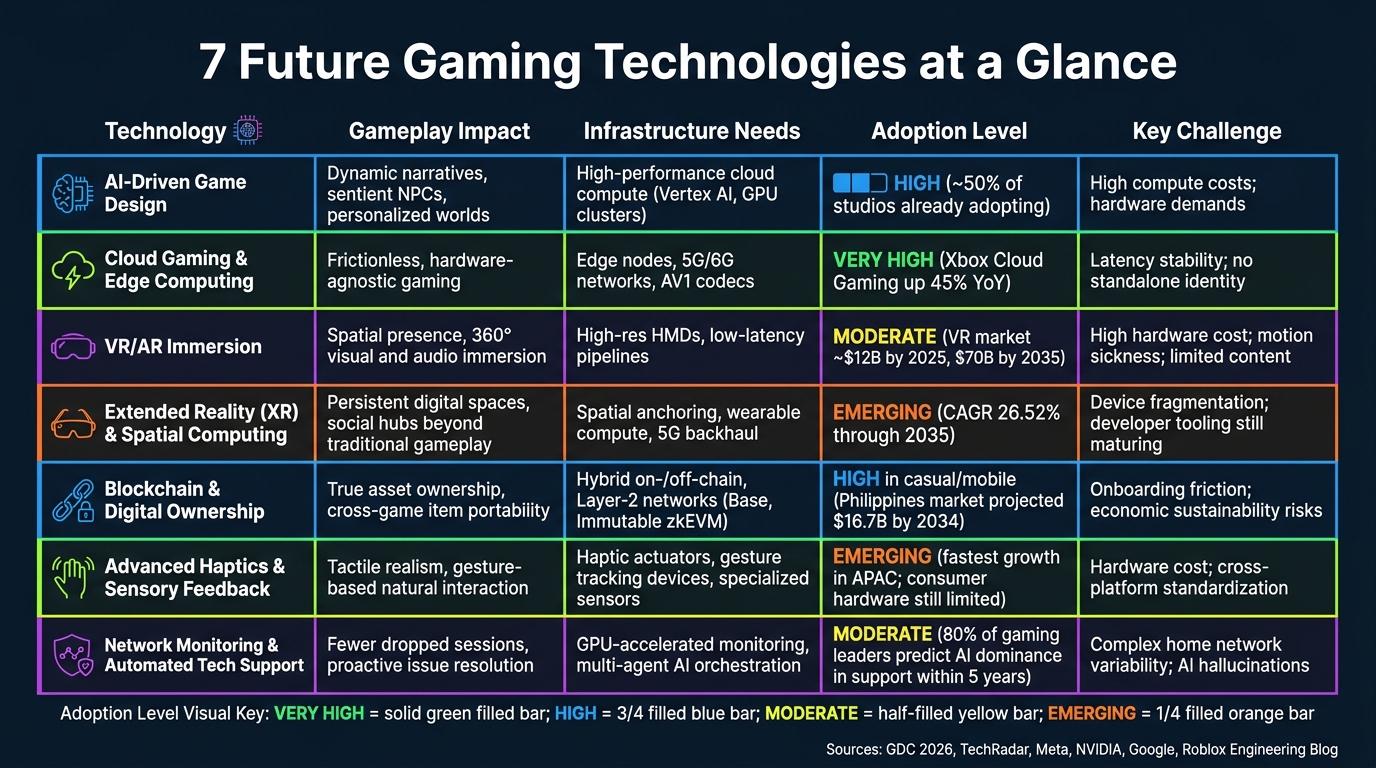
7 Gaming Technologies of the Future: Comparison of Impact, Adoption & Challenges
This table provides a side-by-side snapshot of the technologies shaping gaming’s future, highlighting their gameplay enhancements, infrastructure needs, adoption potential, and hurdles.
| Technology | Gameplay Impact | Infrastructure Requirements | Near-Term Adoption Potential | Key Implementation Challenge |
|---|---|---|---|---|
| AI-Driven Game Design | Dynamic narratives, sentient NPCs, personalized worlds | High-performance cloud compute (e.g., Vertex AI, GPU clusters) | High - ~50% of studios are already adopting | High compute costs; hardware demands for local execution |
| Cloud Gaming & Edge Computing | Frictionless, hardware-agnostic gaming experiences | Edge nodes at ISP facilities, 5G/6G networks, modern codecs (AV1) | Very High - Xbox Cloud Gaming usage up 45% YoY as of late 2025 | Latency stability; lacks a standalone identity without an existing library |
| VR/AR Immersion | Spatial presence, 360-degree visual and audio immersion | High-resolution HMDs, low-latency processing pipelines | Moderate - VR market projected at ~$12B by 2025 and $70B by 2035 | High hardware cost; motion sickness; limited mainstream content |
| Extended Reality (XR) & Spatial Computing | Persistent digital spaces, social hubs beyond traditional gameplay | Spatial anchoring systems, wearable compute, 5G backhaul | Emerging - Growing at a CAGR of 26.52% through 2035 | Device fragmentation; developer tooling still maturing |
| Blockchain & Digital Ownership | True asset ownership, cross-game item portability | Hybrid on-/off-chain architecture with Layer-2 networks (e.g., Base, Immutable zkEVM) | High in casual/mobile - Philippines market projected at $16.7B by 2034 | Onboarding friction; economic sustainability risks |
| Advanced Haptics & Sensory Feedback | Tactile realism, gesture-based natural interaction | Haptic actuators, gesture tracking devices (GTDs), specialized sensors | Emerging - Fastest growth in APAC; consumer hardware still limited | Hardware cost; standardization across platforms |
| Network Monitoring & Automated Tech Support | Fewer dropped sessions, proactive issue resolution | Reliable network monitoring systems and analytics | Moderate | Complex home network variability |
Key Takeaways
Technologies like cloud gaming and AI-driven design are leading the charge in adoption because they don’t require players to upgrade their hardware - servers handle the heavy lifting. On the other hand, VR/AR and advanced haptics offer immersive experiences but face challenges like high device costs and limited content availability. Meanwhile, blockchain is making waves in mobile-first, casual gaming markets, especially in Southeast Asia, while XR with spatial computing is still in its early stages as infrastructure develops.
The biggest challenge across all these technologies? Bridging the gap between optimal lab conditions and the unpredictable realities of millions of devices, networks, and user expectations.
"If onboarding is as cumbersome as installing a printer driver, mainstream players will disengage." - FT Games Blog
Whether it’s setting up a crypto wallet or calibrating a haptic vest, friction in the user experience is a common stumbling block. The technologies that successfully reduce these barriers will shape the future of gaming over the next decade. This comparison highlights how addressing practical challenges is essential for gaming technology to truly evolve.
Conclusion
From AI creating immersive worlds to blockchain enabling genuine digital ownership, gaming is evolving at an incredible pace. Cloud and edge computing are lowering the barrier to entry by cutting out the need for expensive hardware. Meanwhile, VR, AR, and XR are transforming homes into interactive game spaces, haptic technology is bringing physical sensations into the mix, and network monitoring ensures everything runs smoothly.
At the heart of all these advancements is the network. As cloud gaming grows and AI generates real-time content, a reliable, low-latency connection is absolutely essential. In the U.S., 5G now covers 70% of the population, and edge servers in the top 50 metro areas have reduced round-trip latency to under 20 milliseconds. This infrastructure is what makes cloud gaming and real-time AI experiences possible.
For gamers, staying ahead in this rapidly changing landscape starts with robust home connectivity. Upgrading to a WiFi 6 or WiFi 6E router can handle the demands of 8K VR and cloud streaming far better than older models. And with GPU prices continuing to rise, cloud gaming is becoming a more cost-effective option for those who want top-tier performance without constantly upgrading hardware.
On the support side, automation is becoming just as vital as gameplay itself. Within five years, 80% of gaming industry leaders predict AI will dominate player support. Faster troubleshooting, proactive issue prevention, and reduced downtime will be just as critical to the gaming experience as cutting-edge graphics and smooth frame rates.
"The gaming industry doesn't need to build an AI infrastructure. Gamers already did. Studios just need to use it." - Veriprajna Research
The gap between futuristic tech and everyday gaming is closing quickly. Gamers and studios that embrace these changes early - by investing in better networks, tools, and support systems - will shape the future of gaming for years to come. Together, these innovations are creating a gaming world driven by connectivity and player empowerment.
FAQs
What internet speed do I need for cloud gaming?
For cloud gaming, a minimum internet speed of 10-15 Mbps is required for basic functionality. However, if you're aiming for smoother gameplay in HD, you'll want at least 25 Mbps. For those seeking 4K gaming with minimal lag, a connection speed of 45-50 Mbps is ideal. In general, faster internet speeds ensure a more seamless and enjoyable gaming experience.
Will AI make games feel less fair or predictable?
AI has the potential to make games feel more dynamic and engaging without compromising fairness. Adaptive systems can tweak gameplay in real time based on how players interact with the game, offering tailored challenges and unique storylines. This added unpredictability keeps players on their toes, making the experience more immersive. However, fairness remains a cornerstone of game design. Developers focus on creating systems that balance unpredictability with clear, responsive mechanics, ensuring players feel the game is challenging but not unfair. The goal is to make unpredictability an exciting feature, not a frustrating flaw.
Do I really own blockchain game items if a game shuts down?
When a blockchain game shuts down, ownership of in-game items isn’t always secure. Access to these assets often hinges on the platform's licensing agreements. If the service ends, your access to these items can be revoked or lost entirely. While blockchain technology does provide some advantages in terms of ownership, it doesn’t guarantee complete control or lasting access to your in-game assets.