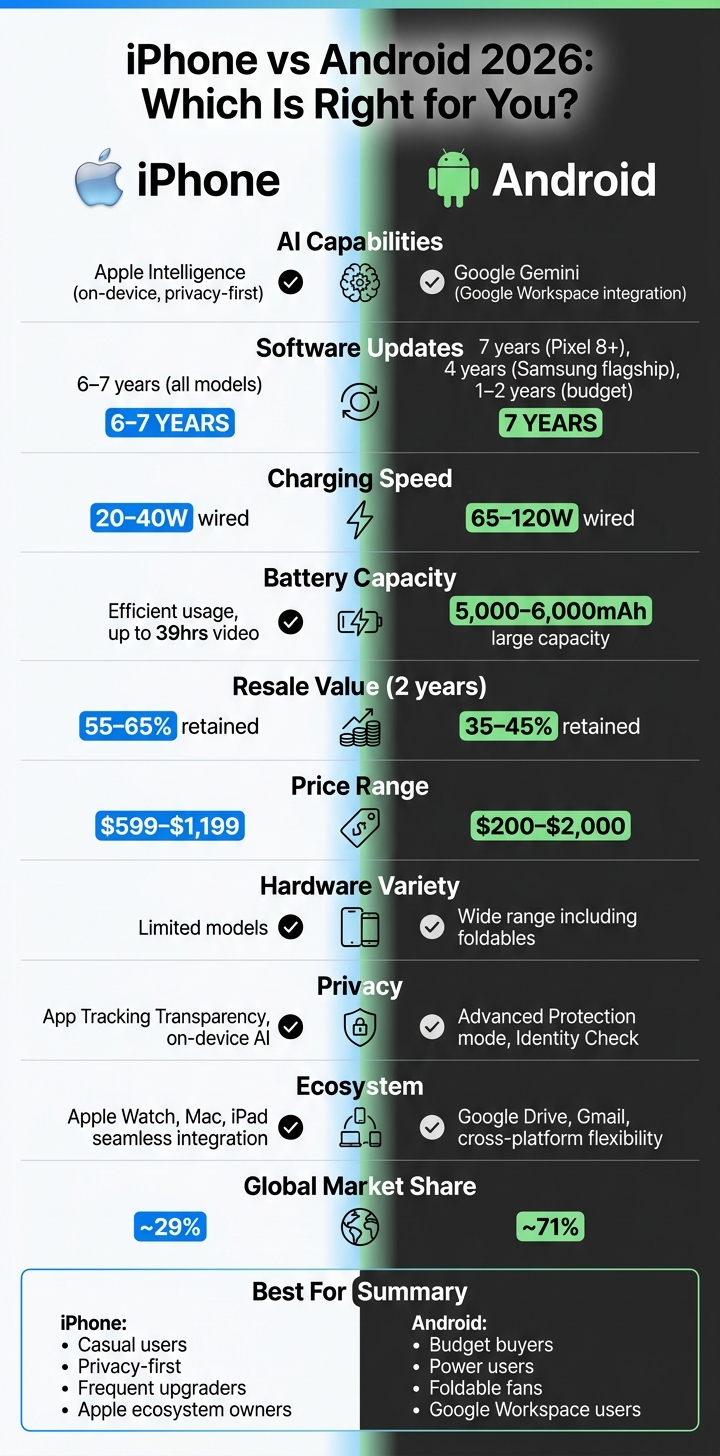
Choosing between iPhone and Android in 2026 comes down to your priorities. Both platforms have reached a point where AI, hardware, and software updates are top-notch, but they cater to different needs. Here’s the quick breakdown:
- iPhone: Best for those who value long-term updates (6–7 years), privacy, resale value (60–70% after 2 years), and seamless integration with other Apple products.
- Android: Ideal for users seeking variety in hardware, foldable phones, faster charging (65–120W), and more affordable options under $400.
Quick Comparison
| Feature | iPhone | Android |
|---|---|---|
| AI Capabilities | Apple Intelligence (on-device privacy) | Google Gemini (Google Workspace integration) |
| Hardware Variety | Limited models | Wide range, including foldables |
| Software Updates | 6–7 years | 7 years (Pixel 8+), varies for others |
| Charging Speeds | 20–40W | 65–120W |
| Battery Life | Efficient usage | Larger capacities (5,000–6,000mAh) |
| Resale Value | 60–70% after 2 years | 35–45% after 2 years |
| Price Range | $599–$1,199 | $200–$2,000 |
Bottom Line: Stick with iPhone if you’re invested in Apple’s ecosystem or prioritize longevity and privacy. Go with Android if you want flexibility, cutting-edge hardware, or a budget-friendly option. Both platforms are stronger than ever - choose based on what fits your lifestyle.
iPhone vs Android 2026: Full Feature Comparison
iPhone in 2026: Features, Strengths, and Limitations
iPhone Hardware in 2026
The iPhone 17 lineup showcases some impressive advancements. At its core is the A19 chip, built on a 3nm process, designed to handle everyday tasks and AI with ease. Apple has also bumped up the RAM, with the base iPhone 17 now featuring 8GB, while the Pro Max packs 12GB, ensuring smoother performance, especially for AI-driven features.
The display has seen a noticeable upgrade. Both models now offer a peak brightness of 3,000 nits, and for the first time, ProMotion (1–120Hz adaptive refresh) is included on the base model. The screen size on the base model has also increased to 6.3 inches, compared to 6.1 inches in earlier versions.
Camera enthusiasts will appreciate the triple-lens 48MP system on the iPhone 17 Pro, which includes a periscope telephoto lens capable of 4x optical zoom. The front camera has been upgraded from 12MP to 18MP. Charging is faster too, with 40W wired charging (50% in about 25 minutes) and 25W MagSafe wireless charging.
However, there’s a trade-off: Apple has switched from titanium to aluminum frames for the Pro models. While this makes the devices lighter and improves heat management, it also reduces durability.
| Feature | iPhone 17 | iPhone 17 Pro Max |
|---|---|---|
| Display | 6.3-inch OLED | 6.9-inch OLED |
| Peak Brightness | 3,000 nits | 3,000 nits |
| Chip | A19 | A19 |
| RAM | 8GB | 12GB |
| Main Camera | Dual 48MP | Triple 48MP |
| Wired Charging | 40W | 40W |
| Battery | 3,692 mAh | 5,088 mAh |
| Video Playback | Up to 30 hours | Up to 39 hours |
These updates continue to build on Apple’s reputation for delivering reliable performance and cutting-edge features.
iOS 26 and the Apple Ecosystem
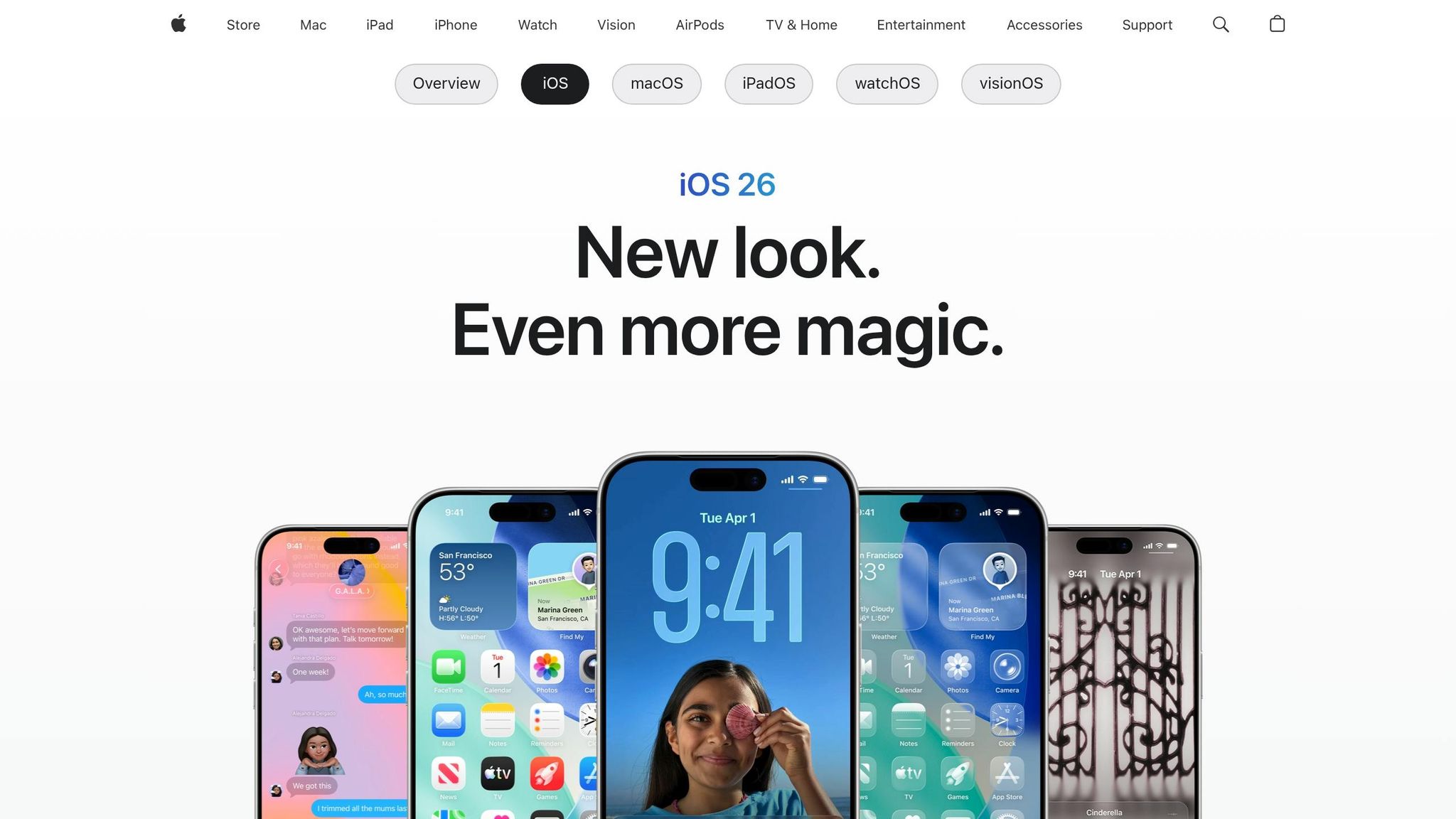
With iOS 26, Apple introduces Apple Intelligence, a suite of AI tools designed to run directly on the device, ensuring user privacy. Siri has also become more capable, now handling multi-step tasks across apps with ease.
The iPhone’s real strength lies in its seamless integration with the Apple ecosystem. Features like Handoff, Universal Clipboard, and Continuity Camera make switching between an iPhone, Mac, or iPad almost effortless. Additionally, iOS 26.3 introduces a wireless method for transferring files, contacts, messages, and even eSIMs to Android devices.
These software updates, combined with the hardware improvements, create a user experience that feels polished and cohesive.
Software Support, Security, and Privacy
Apple continues to lead in long-term support, with iPhones in 2026 guaranteed to receive 6–7 years of major iOS updates. This means an iPhone 17 purchased today will remain current well into the 2030s. Privacy remains a cornerstone of the platform, with features like App Tracking Transparency (ATT) giving users control over app tracking. ATT has even had a significant impact on companies like Facebook, reportedly reducing their revenue by $10 billion in 2022.
Apple also ensures that security patches are rolled out quickly and consistently across all supported devices, offering peace of mind for users.
Pricing, Trade-Ins, and Total Cost of Ownership
Apple’s advancements come with a price, but the iPhone’s value proposition remains strong due to its resale value and durability.
| Model | Starting Price (256GB) |
|---|---|
| iPhone 17e | $599 |
| iPhone 17 | $799 |
| iPhone 17 Air | $999 |
| iPhone 17 Pro | $1,099 |
| iPhone 17 Pro Max | $1,199 |
The iPhone 17 lineup starts at $799 for 256GB, which doubles the base storage of the previous generation without increasing the entry price. iPhones also retain 55–65% of their resale value after two years, far outperforming flagship Android devices, which hold only 35–45%. Apple’s trade-in program adds further value, offering between $200 and $700 for models as old as the iPhone 13, while carrier promotions can go as high as $1,100.
Durability has also improved with Ceramic Shield 2, which offers three times better scratch resistance. However, repairs can be costly - a cracked Pro screen without AppleCare+ can set you back between $280 and $350. For many, investing in AppleCare+ becomes a smart choice.
"iPhone Air is a brand-new member of the iPhone family that delivers advanced features our users will love... all in a breakthrough design that feels like you're holding the future." - John Ternus, Senior Vice President of Hardware Engineering, Apple
sbb-itb-dc5b06c
Android in 2026: Features, Strengths, and Limitations
Android Hardware Options in 2026
Android's lineup in 2026 offers something for everyone. Whether you're after an affordable smartphone or the latest foldable tech, there's an Android device to match your needs.
At the premium end, the Samsung Galaxy S25 Ultra stands out with its impressive 200MP main camera and a new 50MP ultra-wide lens, powered by the Qualcomm Snapdragon 8 Elite chip. Meanwhile, the Google Pixel 10 Pro shines with its Tensor G5 processor and Google's renowned computational photography, featuring a 100x Pro Res Zoom for incredible detail. For those drawn to foldable devices, the Galaxy Z Fold 7 raises the bar with a thinner design - 26% slimmer than its predecessor - and an expansive 8-inch internal display.
Battery life is another strong point. The OnePlus 13 packs a 6,000mAh battery and boasts a peak brightness of 4,500 nits, while the Pixel 9a delivers a solid 5,100mAh battery for just $499.
| Device | Chip | Key Feature | Starting Price |
|---|---|---|---|
| Samsung Galaxy S25 Ultra | Snapdragon 8 Elite | 200MP main camera | Premium tier |
| Google Pixel 10 Pro | Tensor G5 | 100x Pro Res Zoom | Flagship tier |
| Samsung Galaxy Z Fold 7 | Snapdragon 8 Elite | 8-inch foldable display | $2,000 |
| OnePlus 13 | Snapdragon 8 Elite | 6,000mAh battery | $900 |
| Google Pixel 9a | - | 5,100mAh battery | $499 |
| Samsung Galaxy A16 5G | Budget chipset | 5G connectivity | Under $200 |
With this hardware variety, Android 16 takes productivity and security to the next level.
What Android 16 Brings to Users
Android 16 focuses on improving productivity and user experience. Released earlier than usual in June, this update ensures faster access to the latest features.
"This is the earliest Android has launched a major release in the last few years, which ensures you get the latest updates as soon as possible on your devices." - Seang Chau, VP and GM of Android Platform
One standout feature is desktop windowing, which allows tablet and large-screen users to open, resize, and arrange multiple app windows for a more laptop-like experience. Additionally, Live Updates in the notification shade let users track ride-shares or food deliveries in real time without opening an app, making multitasking seamless across Android's diverse ecosystem.
On the security front, Advanced Protection consolidates safeguards against harmful apps, scam calls, and online threats into a single toggle. Meanwhile, Identity Check adds biometric verification for extra security when using the device in unfamiliar locations. To top it off, the updated Material 3 Expressive design introduces frosted glass effects, smoother animations, and haptic feedback for sliders, enhancing everyday interactions.
These features ensure a more polished experience, though the speed of updates still depends on the manufacturer.
Security, Updates, and Fragmentation
Android's openness offers variety but comes with challenges. For example, Google Pixel 8 and newer devices receive 7 years of OS and security updates, while Samsung flagships offer 4 years of major updates and 5 years of security patches. However, support for mid-range and budget devices is much shorter. Motorola and OnePlus mid-range models typically get 2–3 years of updates, and many budget devices see only one major update before security patches taper off, leaving them vulnerable over time.
Unlike iOS, which delivers updates to all devices simultaneously, Android updates are staggered by manufacturer and carrier, creating inconsistency. For users who prioritize long-term security, this fragmented approach remains a key drawback.
Affordability and Device Lifespan
Android's pricing range is one of its strongest appeals. You can grab a Samsung Galaxy A16 5G for under $200, a Pixel 9a for $499, or splurge on a Galaxy Z Fold 7 for $2,000. This flexibility has helped Android maintain a commanding 71% share of the global smartphone market.
In the U.S., however, resale value complicates the equation. Android flagships retain only 35–45% of their value after two years, compared to 55–65% for iPhones. While budget Android devices save you money upfront, shorter update cycles may lead to earlier replacements, potentially negating those savings.
Head-to-Head: iPhone vs Android Across Key Areas
Performance, Battery Life, and Reliability
When it comes to performance and efficiency, Apple’s A18 Bionic and A18 Pro chips dominate in single-core tasks and energy efficiency, ensuring a smooth experience for everyday use. Meanwhile, Android flagships powered by the Snapdragon 8 Gen 4 or Tensor G5 excel in multi-core tasks and GPU-heavy gaming.
Charging speeds show a clear difference: Android devices offer wired charging speeds of 65–120W, allowing for a full charge in just 30–45 minutes, whereas iPhones stick to more modest 20–30W charging. However, the iPhone 17 Pro Max shines in battery efficiency, offering up to 29 hours of video playback. Most Android devices rely on larger batteries, typically between 5,000mAh and 6,000mAh, to achieve comparable endurance.
| Metric | iPhone | Android Flagships |
|---|---|---|
| Processor Performance | Single-core & efficiency | Multi-core & GPU power |
| Wired Charging | 20–30W | 65–120W |
| Battery Focus | Longevity & health management | Capacity & fast charging |
| Resale Value (2 years) | 60–70% retained | 40–50% retained |
User Experience and Productivity
Apple’s iOS is all about simplicity and consistency. Its "just works" philosophy ensures a seamless interface with minimal settings. As Michael, Head of Mobile at Wezom, explains:
"iPhone users often note that iOS 'just works.' The interface is intuitive, and the settings are minimal."
Android, on the other hand, caters to those who love customization. You can tweak everything from launchers to home screens and even access the full file system. Features like Samsung DeX take productivity further by offering a desktop-like experience - something iPhones don’t provide.
Both platforms now integrate AI tools to enhance productivity. Apple Intelligence offers system-wide tools and contextual screen awareness, while Google Gemini connects with apps like Gmail and Calendar to streamline workflows. Interestingly, 50% of iPhone users consider AI features important when choosing a device, compared to just 23.7% of Android users.
Ecosystem Integration and Services
The strength of each platform truly shines when you look at how they integrate with other devices and services.
For Apple users, the ecosystem is a major draw. Features like Handoff, AirDrop, and Universal Clipboard make switching between a Mac, iPad, or Apple Watch effortless. Android, however, excels in cross-platform compatibility. Google services like Drive, Photos, and Gmail work seamlessly across Windows, Mac, and ChromeOS, offering flexibility.
The Apple Watch, exclusive to iPhones, adds another layer to Apple’s ecosystem, with around 35% of U.S. iPhone users owning one. Android users, meanwhile, benefit from a wider range of smartwatch options.
"Apple's ecosystem creates compelling reasons to add more Apple products, which generates revenue and reduces churn." - When Notes Fly
Both platforms now support the Matter smart home standard. Apple’s HomeKit emphasizes local control, while Android leans on cloud-based integrations like Google Home and Amazon Alexa.
Security, Privacy, and Compliance
Both platforms prioritize security, but their approaches to privacy differ.
Apple’s App Tracking Transparency (ATT) gives users control over app tracking, while Android 16 introduces an Advanced Protection mode, bundling defenses against malicious apps, scam calls, and phishing. Android’s Identity Check also adds biometric verification for extra security in unfamiliar locations. While both systems are robust, Apple’s privacy controls are often more user-facing.
Software Longevity, Updates, and Support
Apple stands out with 6–7 years of iOS updates for its devices. Google matches this for Pixel 8 and newer models, offering 7 years of updates. Samsung provides 4 years of major OS updates and 5 years of security patches for its flagship devices. However, mid-range and budget Android phones typically see only 1–2 years of major updates and 2–3 years of security patches.
| Manufacturer | Major OS Updates | Security Patches |
|---|---|---|
| Apple | 6–7 years | 6–7 years |
| Google Pixel (8+) | 7 years | 7 years |
| Samsung (Flagship) | 4 years | 5 years |
| OnePlus (Flagship) | 3 years | 4 years |
| Motorola (Flagship) | 2 years | 3 years |
| Budget Android | 1–2 years | 2–3 years |
Repair costs also differ. Out-of-warranty screen repairs for iPhones range from $280–$350, while flagship Android phones cost $200–$280. These factors play a big role in determining the long-term value of each platform.
iPhone vs Android 2026 - Stop Ignoring The Truth
Conclusion: Which Platform Is Right for You?
There’s no universal winner here - what matters most is finding the platform that aligns with your needs.
Best Platform by User Type
Here’s a quick breakdown to help you decide based on your priorities:
| User Type | Best Fit | Why |
|---|---|---|
| Casual, everyday users | iPhone | Easy to use, dependable, and requires minimal setup |
| Power users & multitaskers | Android | Offers split-screen features, file management, and deep customization |
| Budget-conscious buyers | Android | Delivers more features in the $200–$400 range than any iPhone |
| Frequent upgraders | iPhone | Retains 60–70% resale value after two years, compared to 40–50% for Android flagships |
| Privacy-first users | iPhone | Includes App Tracking Transparency and on-device AI processing |
| Google Workspace users | Android | Seamless integration with Gmail, Calendar, and Drive via Gemini |
| Foldable enthusiasts | Android | Leads the foldable market with standout devices like the Galaxy Z series and Pixel Fold |
As Wispr Flow puts it:
"Android is the productivity choice for power users who want to build highly personalized workflows."
Key Takeaways for 2026
Here’s the bottom line: Apple and premium Android brands now both offer 7 years of software updates, but budget Android models still fall behind with only 2–3 years of major updates. If you’re shopping under $400, this is a critical consideration. On the other hand, if you upgrade frequently, the iPhone’s higher resale value can help offset its upfront cost, while Android continues to dominate on price and hardware variety.
Already invested in the Apple ecosystem with a Mac, iPad, or Apple Watch? Or heavily reliant on Google Workspace? Switching platforms can add complications and hidden costs. Stick with the platform that complements your existing tools and workflow, rather than chasing flashy launch-day features.
FAQs
Which iPhone and Android models get 7 years of updates?
iPhone models, starting with the iPhone 6s and newer, generally benefit from about 7 years of software updates. In some cases, they even receive security patches for close to a decade. On the Android side, Samsung Galaxy devices, including the Galaxy S24 and S25 series, now also promise up to 7 years of updates. This extended support for flagship devices on both platforms ensures they remain functional and secure for years.
What hidden costs should I expect if I switch platforms?
Switching between an iPhone and an Android in 2026 could come with costs that aren’t immediately obvious. For instance, transferring data - especially if you’re dealing with eSIMs or large files - might incur extra fees. Then there’s the issue of apps and subscriptions. Some apps or services you’ve purchased may only work on one platform, meaning you’ll need to pay again for their counterparts.
You’ll also want to consider accessory compatibility. New chargers, cases, or other add-ons might be necessary if your existing ones don’t work with your new device. Finally, moving services like iCloud or Google Drive could require upgrading to premium plans for a smoother transition. These hidden costs can add up fast, so it’s worth planning ahead.
How do I compare total ownership cost beyond the sticker price?
To truly understand the cost of ownership beyond the initial price tag, you need to consider aspects like device lifespan, software updates, maintenance expenses, and the overall value of the ecosystem.
For instance, iPhones tend to hold their value longer and consistently receive software updates, which can minimize security risks and performance issues over time. On the other hand, Android devices often offer greater customization options but may come with higher repair or upgrade expenses.
By assessing factors like how long the device will last, the level of update support, and how well it integrates with accessories, you can get a clearer picture of the real cost over time.