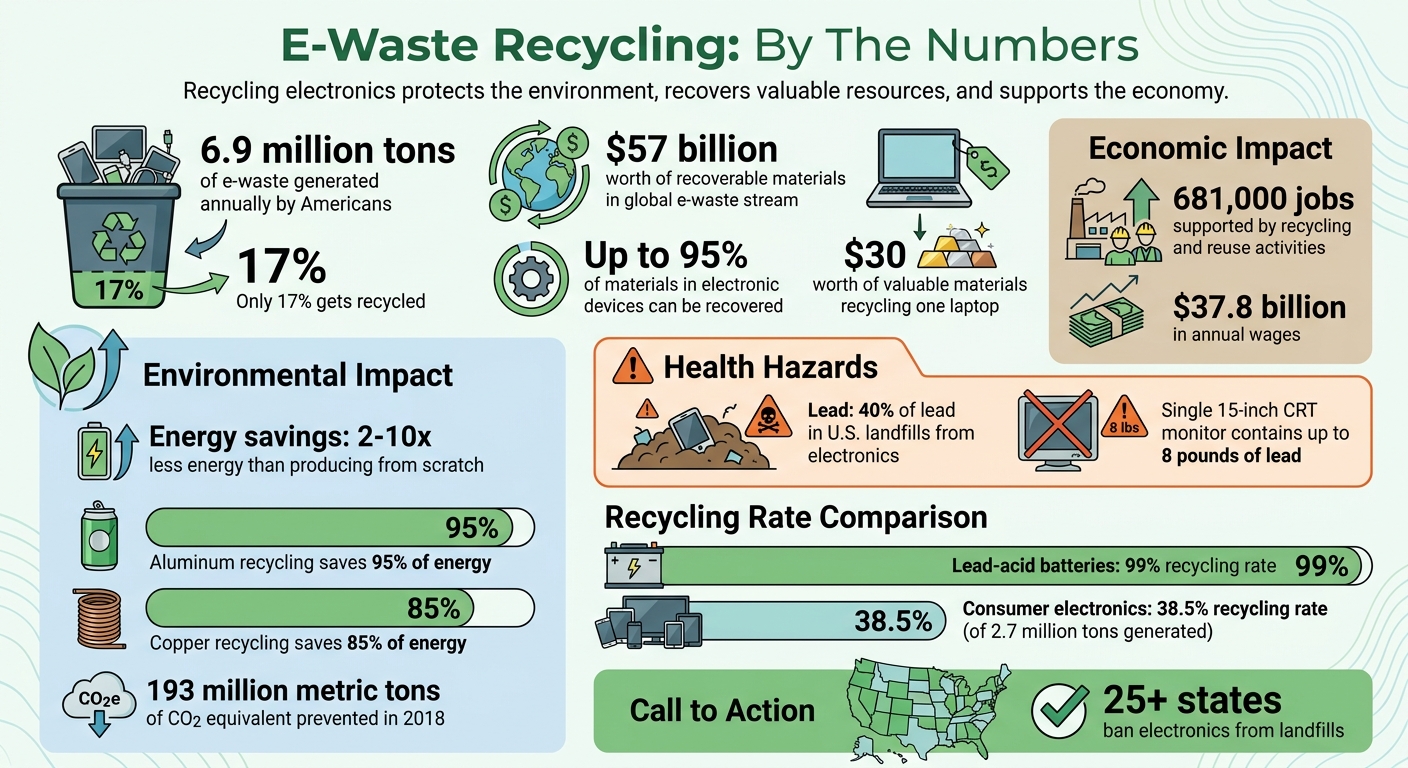
Each year, Americans generate 6.9 million tons of electronic waste, yet only 17% of it gets recycled. This waste contains valuable materials like copper and gold but also toxic substances such as lead and mercury, which can harm the environment and public health if improperly disposed of. Recycling programs - offered by governments, retailers, and manufacturers - help recover resources, reduce pollution, and ensure safe handling of hazardous materials.
Here’s what you need to know:
- Why it matters: Prevents toxins from polluting landfills, conserves resources, and supports jobs.
- How it works: Drop off items at certified facilities, retailer programs, or mail-in services for proper dismantling and material recovery.
- What to do: Securely erase data, remove batteries, and check for trade-in options before recycling.
- Where to go: Use tools like Earth911, Call2Recycle, or certified recyclers (R2, e-Stewards) to find nearby programs.
Recycling electronics responsibly not only protects the environment but also reclaims valuable materials and reduces risks to public health. Let’s dive into how these programs operate and how you can participate.
E-Waste Recycling Statistics and Environmental Impact in the United States
Electronic Recycling: Protecting Your Data and the Environment
sbb-itb-dc5b06c
Why E-Waste Recycling Programs Matter
E-waste recycling programs play a pivotal role in protecting the planet, supporting economic growth, and safeguarding public health. By keeping harmful materials out of landfills and recovering valuable resources, these programs offer benefits that go far beyond waste management.
Environmental Benefits
Recycling electronics keeps toxic substances from polluting soil and water. When discarded in landfills, metals can leach into the environment or release harmful emissions during incineration. Recycling not only prevents this but also conserves energy - saving between 2 and 10 times the energy needed to produce materials from scratch. For example, recycling aluminum saves a staggering 95% of the energy required for new production, and recycling copper saves 85%.
"Electronic products are made from valuable resources and materials, including metals, plastics, and glass, all of which require energy to mine and manufacture." – US EPA
Recycling also reduces the need for mining, which can devastate ecosystems by degrading land, polluting water, and destroying habitats. In 2018 alone, recycling and composting municipal solid waste in the U.S. prevented over 193 million metric tons of carbon dioxide equivalent from entering the atmosphere. Alongside these environmental benefits, recycling recovers materials that hold significant economic value.
Economic Value of Material Recovery
The global e-waste stream contains an estimated $57 billion worth of recoverable materials. These materials, once purified, can be resold to manufacturers, creating a circular economy that lowers production costs and generates employment. Impressively, up to 95% of materials in electronic devices can be recovered. For instance, recycling just one laptop can yield around $30 worth of valuable materials.
In the U.S., recycling and reuse activities directly support around 681,000 jobs and contribute $37.8 billion in annual wages. This demonstrates how e-waste recycling not only benefits the environment but also bolsters the economy.
Health and Safety Impacts
Beyond environmental and economic advantages, e-waste recycling protects public health. Certified recycling facilities use specialized processes to safely handle hazardous components found in electronics. For example, lead-filled glass from CRT monitors and mercury from flat-screen backlights are carefully removed before further processing. Without proper recycling, these toxic substances pose serious health risks. In fact, discarded electronics contribute about 40% of the lead content in U.S. landfills, with a single 15-inch CRT monitor containing up to 8 pounds of lead.
| Hazardous Material | Common Source | Health Impact |
|---|---|---|
| Lead | CRT monitors, circuit board solder | Brain damage, kidney failure, nervous system damage |
| Mercury | Flat-screen backlights, switches | Neurotoxin affecting development and coordination |
| Cadmium | Rechargeable batteries and circuit boards | Carcinogen, kidney damage |
| Chromium | Protective coatings, metal housings | Respiratory irritant, carcinogen |
| Flame Retardants | Plastic casings, circuit boards | Endocrine disruptors |
Certified recycling programs also reduce the export of e-waste to developing nations, where informal recycling methods - like burning wires or using acid baths - release dangerous toxins into local environments. Choosing recyclers with R2 or e-Stewards certifications ensures that e-waste is handled responsibly, with strict safety measures in place throughout the entire process.
How E-Waste Recycling Works
Learning about the recycling process can help you make smarter choices about how to dispose of your old electronics. The journey from your outdated smartphone to valuable raw materials involves several carefully planned steps. Each stage focuses on recovering materials, protecting data, and minimizing environmental harm.
Collection and Transportation
E-waste enters the system through various channels. Local drop-off sites often accept electronics from residents, usually requiring a quick ID check. Retailers also provide take-back kiosks where you can leave small devices during store hours. For branded products, manufacturers often offer mail-in programs with prepaid shipping labels. Businesses with large amounts of e-waste can arrange pickups - usually free for five or more pallets, though smaller loads might cost $100 to $300 per pallet.
Sorting and Dismantling
After collection, electronics are sorted by type and logged for tracking. Technicians inspect items to see if they can be refurbished. Usable devices are often resold to schools or nonprofits. Broken or outdated items move to the dismantling phase, where hazardous parts like batteries, circuit boards, and mercury switches are carefully removed by hand. This stage also ensures secure data destruction. Devices with data are wiped using software that meets NIST 800-88 standards, degaussed for magnetic media, or physically shredded. These methods are crucial, as improper disposal can lead to data breaches costing U.S. businesses an average of $9.44 million per incident.
Material Recovery and Processing
Once dismantled, the remaining materials are shredded in two stages - first into pieces about 100mm in size, then down to roughly 10mm fragments. Automated systems then separate the materials. Magnets extract ferrous metals, while eddy current separators handle non-ferrous metals like aluminum and copper. Glass and plastics are sorted using density-based methods. Circuit boards are sent to specialized refiners, where precious metals are recovered using chemical or thermal processes. Plastics are sorted by resin type and turned into pellets for reuse in manufacturing. These advanced techniques make it easier to find trustworthy e-waste recycling programs near you.
Finding E-Waste Recycling Programs in the United States
Once you’re ready to recycle your electronics, the next step is finding a program that works for you. Across the United States, there are plenty of options, including local government services, community initiatives, certified recycling providers, and retailer take-back programs.
Local Government and Community Programs
Many cities and counties provide e-waste collection services. Tools like Earth911 and Greener Gadgets make it easy - just enter your zip code to find nearby drop-off points. For recycling cell phones and batteries, Call2Recycle is another great resource. State-level directories, such as California’s CalRecycle, also list approved recyclers. Notably, starting January 1, 2026, California’s Covered Electronic Waste Recycling Program has expanded to include products with embedded batteries.
Check with your local government or community center about collection days or permanent drop-off sites. Before heading out, confirm which items are accepted and whether fees apply. It’s also a good idea to remove lithium-ion batteries from devices, as these require separate handling. For more secure and environmentally responsible options, consider certified recycling providers.
Certified E-Waste Recycling Providers
Certified recyclers ensure high standards for both environmental practices and data security. Two widely recognized certifications are R2 (Responsible Recycling) and e-Stewards. R2 focuses on safe handling, worker safety, and material tracking, while e-Stewards takes it a step further by banning hazardous waste exports to developing nations and prohibiting landfilling or incineration.
To find certified recyclers, use tools like the SERI directory for R2-certified facilities or the e-Stewards directory. Before dropping off your electronics, verify the recycler’s certification, confirm their address, and check the expiration date on their certificate. Businesses, in particular, should request a serialized Certificate of Destruction, which includes equipment serial numbers and the destruction methods used. Additionally, ask about their downstream partners to ensure materials are handled responsibly through final processing. If you’re looking for even more options, many manufacturers and retailers have take-back programs worth exploring.
Retailer and Manufacturer Take-Back Programs
Retailer programs are a convenient way to recycle old electronics. Best Buy, for instance, runs the largest retail e-waste collection program in the U.S., having collected 2.7 billion pounds of electronics and appliances since 2009. You can drop off items at any store or use their mail-in service.
"Our recycling and trade-in programs help our customers throughout the lifecycle of their products by keeping old tech out of landfills and giving it a second life." – Best Buy
Google also offers a free mail-back recycling program through partners like Reverse Logistics Group (RLG) and ERI. This program accepts Google-branded devices, as well as smartphones, tablets, fitness trackers, and accessories from other manufacturers. Other major brands, such as Samsung, LG, Sony, and HP, have partnered with specialized recyclers to provide prepaid shipping labels or drop-off options.
Most take-back programs are simple to use, whether through in-store kiosks, prepaid mail-back labels, or trade-in programs that offer store credit for devices in working condition. Just don’t forget to perform a factory reset on your device before recycling!
What to Expect When Using E-Waste Recycling Programs
Once you've picked an e-waste recycling program, it's important to know what the process involves. While most programs are simple to use, you'll need to take a few key steps - especially when it comes to securing your personal data, understanding potential costs, and knowing what items are accepted.
Handling Sensitive Data
Protecting your personal data is crucial. Simply deleting files or formatting a device won't erase data permanently - special tools can still recover it.
Before recycling, back up your files. You can use cloud services like OneDrive, Google Drive, or Dropbox, or an external drive with tools like Windows File History or Mac Time Machine. Also, deactivate software licenses (like Adobe Creative Cloud) to use them on a new device. Don’t forget to remove SIM and memory cards from your gadgets.
To erase data securely:
- Windows devices: Go to Settings > Recovery > Reset this PC, then select Remove everything and enable Clean data.
- Mac devices (Ventura or later): Use System Settings > General > Transfer or Reset > Erase All Content and Settings, which also signs you out of iCloud and deletes accounts, media, and Touch ID data.
- Mobile devices: Perform a factory reset, following NIST 800-88 standards.
For devices with highly sensitive data, professional destruction services may be worth considering. Options include:
- Certified software wiping: $15–$40 per device
- Degaussing (for traditional hard drives): $8–$20 per drive
- Physical shredding: $10–$25 per hard drive, reducing it to particles smaller than 1 inch.
Always ask for a serialized Certificate of Destruction from your recycler. This document should include the device's serial number and the destruction method used.
Once your data is secure, review any potential fees before proceeding.
Fees or Free Services
Recycling costs can vary. Many programs are free, especially for smaller items like phones, tablets, and laptops. Retailers such as Best Buy, Staples, and Apple offer free drop-off services, often regardless of where the item was purchased. In some states like California, recycling fees are prepaid at the time of purchase (ranging from $4 to $7), which covers future recycling costs. Since 2005, California's program has paid out over $1.3 billion in recycling incentives and compensates recyclers up to $0.49 per pound for items like laptops and monitors.
Specialized services may come with fees. For example:
- Best Buy: Charges $199.99 to haul away two large appliances and unlimited smaller items.
- Mail-in programs: Range from $14.19 for small Staples boxes to $29.99 for medium Best Buy boxes (up to 15 lbs).
- Appliances with refrigerants: Disposal fees of $10–$25.
Before recycling for free, check if your device has trade-in value. Retailers like Amazon, Walmart, and Apple often offer gift cards or discounts for functional devices. Staples Rewards members can earn points for recycling, and some stores provide perks - like 25% off Logitech products - for recycling old equipment.
Accepted and Restricted Items
Knowing what items are accepted can save you time and hassle. Most programs accept:
- Computers (desktops and laptops)
- Mobile devices (smartphones, tablets, wearables)
- Monitors (LCD/LED)
- Printers, scanners, routers, and peripherals (keyboards, mice) .
Many also accept batteries (lithium-ion, lead-acid, nickel-cadmium), but these often need to be removed from devices and recycled separately. To avoid short circuits, tape or bag the battery terminals .
However, older CRT monitors and TVs may be restricted or require a fee due to their hazardous lead content and higher handling costs. Policies vary by location, so it's a good idea to call ahead. Some programs accept unique items - Best Buy, for instance, takes fitness equipment and large appliances, while Staples even recycles crayons.
Keep in mind that e-waste typically isn't accepted in curbside recycling because of its toxic components, which can harm the environment if improperly disposed of . While lead-acid batteries had a recycling rate of 99% in 2018, only about 38.5% of the 2.7 million tons of consumer electronics generated that year were recycled.
To ensure safe and responsible recycling, choose programs certified by R2 or e-Stewards. These certifications guarantee high safety and environmental standards . For large quantities of batteries, use UN-rated containers and follow hazmat shipping guidelines.
Conclusion
This guide has highlighted the many ways e-waste recycling supports the environment, boosts the economy, and protects public health. By recycling electronics, we prevent harmful materials from polluting ecosystems, recover useful resources like metals, and even protect sensitive personal data. With only 17% of e-waste recycled in the United States, there's plenty of room for individuals and communities to step up and contribute to meaningful change. Recycling millions of devices not only saves energy but also reclaims valuable materials that would otherwise go to waste.
The good news? Getting involved in e-waste recycling is simpler than ever. Certified programs are readily available through major retailers, manufacturers, and local governments. Plus, with more than 25 states banning electronics from landfills, recycling isn’t just a smart choice - it’s often a legal requirement.
Before dropping off your devices, take a few precautions: wipe your data using factory resets or certified software, safely remove batteries and tape their terminals, and check if your device qualifies for a trade-in program. To ensure your electronics are handled responsibly, always opt for recyclers certified by R2 or e-Stewards.
Whether you're upgrading a phone, replacing an old laptop, or cleaning out outdated gadgets, recycling responsibly makes a real difference. It conserves resources, keeps toxic substances out of landfills, and supports a circular economy that benefits everyone. Find a certified recycling program near you and turn your old tech into a positive environmental impact.
FAQs
How do I know a recycler won’t export or landfill my e-waste?
To make sure your e-waste doesn’t end up improperly exported or dumped in a landfill, check if the recycler is certified by a recognized third-party auditor. Certifications like R2 or e-Stewards® indicate that the recycler follows strict guidelines for handling materials safely and responsibly. These certifications also help ensure that e-waste is managed within the U.S., preventing it from being shipped to countries with less stringent environmental regulations.
What’s the safest way to erase data before I recycle a device?
To ensure your data is securely erased, start by backing up any important files you want to keep. Next, remove both the SIM and SD cards from your device. Then, perform a factory reset or use specialized data-wiping tools to clear all personal information. For an extra layer of security, consider physically destroying the storage media - like hard drives - by drilling holes into them or shredding them. These precautions help safeguard your personal information before recycling or disposing of your device.
Can I recycle electronics with built-in batteries, and what should I do first?
Yes, electronics with built-in batteries, including lithium-ion types, are recyclable. To reduce the risk of fires and minimize environmental harm, make sure to tape the battery terminals or place them in individual plastic bags before recycling. You can use tools like Earth911 or Call2Recycle to locate nearby facilities that accept batteries and electronic waste. Taking these steps ensures safe and responsible recycling.